
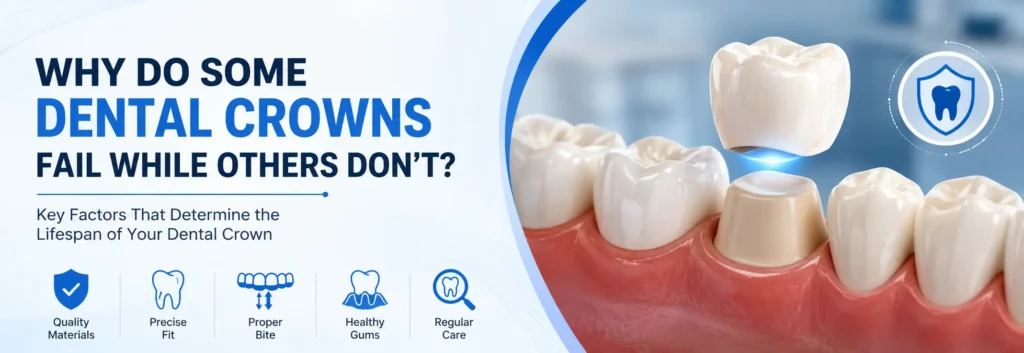
Why Do Some Dental Crowns Fail While Others Do Not?
Not every crown lasts the same amount of time, even when two people get the exact same procedure. One patient walks around for fifteen years without a second thought, while another is back in the chair within eighteen months wondering what went wrong. The gap usually comes down to a handful of factors most people never think to ask about.
What a Crown Is Actually Supposed to Do
A crown covers a damaged or weakened tooth and takes over the job that tooth used to do on its own. It has to handle biting force, resist wear, and seal out bacteria for years at a stretch. That is a lot to ask from a single piece of material sitting on top of a tooth that is already been through some kind of trauma.
When everything lines up right, a crown can genuinely feel like a natural part of your mouth. When it does not, small problems tend to show up early and only get worse from there. The tricky part is that early warning signs are often subtle enough to ignore, which is exactly how minor issues turn into bigger failures down the road.
Material Choice Matters More Than People Realize
Not all crowns are built the same way, and the material used plays a bigger role in longevity than most patients expect. Porcelain, zirconia, metal, and combination crowns each behave differently under pressure and wear at different rates. Some materials handle heavy grinding well but chip more easily, while others resist chipping but wear down opposing teeth faster than expected.
Custom dental crowns built for a person’s specific bite and jaw movement tend to hold up far better than anything made from a generic mold. Fit and material both need to match the person, not just the tooth. A crown chosen based on cost alone, without factoring in how someone actually bites and chews, is already starting off at a disadvantage.
Common Reasons Crowns Fail Early
A few patterns show up again and again when a crown fails sooner than it should. None of these are particularly rare, which is part of why crown failure is more common than people assume.
- Poor fit that leaves gaps for bacteria to sneak in
- Grinding or clenching that puts uneven pressure on the crown
- Decay forming underneath the crown at the gum line
- A weak or cracked tooth structure underneath that could not hold up
- Low-quality materials that wear down faster than expected
- Cement breaks down over time and allows movement
Any one of these on its own can shorten a crown’s lifespan. A couple of them together almost guarantees trouble down the line, sometimes within just a year or two of placement.
The Fit Has to Be Precise, Not Just Close
A crown that is slightly off, even by a small margin, creates a gap where bacteria can build up unnoticed. Over months and years, this leads to decay right at the edge of the crown, which is often mistaken for the crown itself failing when it is really the tooth underneath breaking down.
Precise digital scanning and careful lab work reduce this risk significantly. It takes more time and attention up front, but it pays off in how long the crown actually lasts. Older methods that relied heavily on physical impressions left more room for small errors, and those errors compound once the crown is cemented in place and under daily use.
There is also a difference between a lab that mass-produces restorations and one that treats each case individually. A crown built with careful attention to the surrounding teeth, the opposing bite, and the specific gum contour tends to integrate far more naturally than one built purely off a standard template.
Your Bite Plays a Bigger Role Than You would Guess
Grinding your teeth at night, clenching during stressful periods, or having an uneven bite all put extra stress on a crown that it was not necessarily built to handle. Over time, this pressure can crack the material, loosen the cement, or wear down the crown’s surface faster than normal.
This is one reason a proper bite evaluation matters just as much as the crown procedure itself. Treating the crown without addressing the bite behind it often just delays the same problem from happening again. A crown placed on a tooth that is already absorbing uneven forces is essentially fighting an uphill battle from day one.
Patients with a known grinding habit often benefit from a night guard alongside their crown work. This small addition protects the investment made in the crown and reduces the odds of an early fracture or premature wear pattern forming on the biting surface.
The Role of Gum Health Around the Crown
Healthy gum tissue around a crown does more work than people realize. When gums recede or become inflamed, the edge of the crown can become exposed, creating a weak point where bacteria settle in more easily.
Keeping gum tissue healthy around a crowned tooth requires the same attention as natural teeth, sometimes more. Flossing around the crown’s margin and staying consistent with cleanings helps prevent the kind of slow breakdown that eventually undermines even a well-made crown. Gum disease left untreated near a crowned tooth can eventually affect the bone supporting it, which puts the entire restoration at risk regardless of how well it was made.
Why the Dentist Behind the Work Actually Matters
Skill and attention to detail during the procedure make a real difference in how well a crown holds up. Someone searching for the best dentist in Richmond for crown work should look past the marketing and ask about the actual process, the materials used, and how carefully the bite gets checked afterward.
A rushed appointment or a generic approach tends to show up later as sensitivity, discomfort, or a crown that just does not feel right. Careful work at the start almost always saves time and money later, since redoing a failed crown often costs more than doing it properly the first time. It also means going through the discomfort of a second procedure that could have been avoided with more careful planning from the beginning.
Taking Care of a Crown After It is Placed
Even a well-made crown needs some ongoing attention. Skipping regular checkups or ignoring small changes like sensitivity or looseness tends to let minor issues turn into bigger ones.
Basic habits go a long way here too, things like avoiding extremely hard foods, wearing a night guard if grinding is an issue, and keeping up with routine cleanings around the crown’s edges. Patients who stay consistent with these small habits tend to get significantly more years out of their crowns compared to those who treat the crown as maintenance-free once it is placed.
Regular X-rays also play a role in catching problems early, since decay forming underneath a crown often is not visible to the naked eye until it has already progressed. A dentist who checks these areas consistently can often intervene before a small issue turns into a full crown replacement.
Getting a Crown That Actually Lasts
The difference between a crown that lasts a couple of years and one that lasts a couple of decades usually comes down to preparation, fit, material choice, and how the bite gets handled afterward. None of these steps is optional if long-term success is the goal, and cutting corners in any single area tends to shorten the crown’s useful life significantly.
Frequently Asked Questions
How long should a dental crown normally last?
A well-fitted crown made from quality material typically lasts between ten and fifteen years, sometimes longer with good care and regular checkups.
Can a failing crown be fixed instead of replaced?
In some cases, yes. If the crown itself is intact but the fit or bite needs adjusting, a dentist may be able to correct the issue without a full replacement.
What is the biggest sign a crown might be failing?
Sensitivity to hot or cold, a feeling of looseness, or visible dark lines at the gum line near the crown are usually the earliest warning signs worth getting check