
How Does Sleep Apnea Connect To Your Jaw And Bite Alignment?
You can sleep for eight hours straight and still wake up feeling like you got hit by a truck. It happens more often than people admit, and most never think to blame their jaw for it. But the shape of your bite might be quietly working against your sleep every single night.
What Is Actually Happening When You Have Sleep Apnea
Obstructive sleep apnea is basically your throat caving in on itself while you are asleep. The soft tissue back there collapses, air stops moving, and this can happen for ten seconds or more at a stretch. Sometimes it repeats dozens of times an hour, which sounds exhausting because it is.
Your brain notices the blockage almost instantly and jolts you awake just enough to clear it, even if you never fully realize it happened. String enough of these interruptions together, and you never get the deep sleep your body actually needs to recover. You can spend a full night in bed and still feel like you barely slept at all.
Why Your Jaw Has More To Do With This Than You Would Think
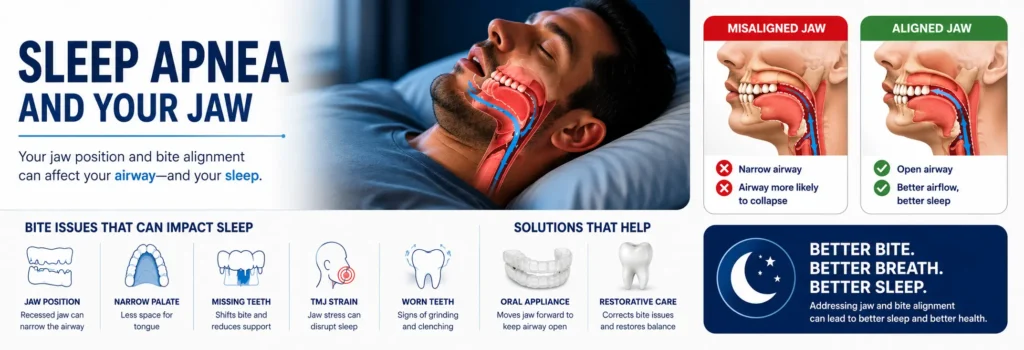
Here is the part most people miss. Your jaw is not just for chewing. It physically holds space open behind your tongue and throat. If your lower jaw sits too far back, that space shrinks, and there is simply less room for air to move through comfortably.
A recessed or narrow jaw leaves your tongue with nowhere to go but backward when you lie down. That alone can start narrowing the airway before any tissue even collapses. It is one of those quiet structural problems that builds for years before anyone connects the dots.
How A Misaligned Bite Makes Things Worse
Sometimes it is not just the jaw’s position; it is how the teeth actually meet. A bite that is off can drag the jaw into a spot that makes breathing at night even harder. A few patterns show up again and again in people dealing with this.
- A deep overbite pulling the lower jaw backward
- A narrow upper palate that crowds the tongue
- Missing molars letting the whole bite cave inward
- Jaw joints worn unevenly after years of pressure
None of these happen overnight. They creep in slowly, and by the time someone notices the snoring or the constant tiredness, the bite has usually shifted quite a bit already.
Signs Worth Paying Attention To
There are physical clues that your jaw might be part of the problem, and a lot of them are easy to spot once you know what to look for. This is often where a sleep apnea dentist starts looking during a first visit.
- Teeth that look flatter or more worn than they used to
- Waking up with a sore, tight jaw for no clear reason
- Clicking or popping when you open your mouth
- A smaller or more recessed chin
- Snoring paired with headaches most mornings
If you are noticing two or three of these at once, it is probably not a coincidence. That combination usually means the bite and the airway are not working together the way they should.
Getting The Bite Properly Checked
A real evaluation is not just a quick look for cavities. It means studying how your upper and lower teeth actually come together, how the jaw joints move, and where your tongue naturally sits when you are relaxed or asleep.
Digital scans make this a lot more precise than it used to be. They let a dentist see exactly how far the jaw has shifted and whether that shift is feeding into the airway problem or just sitting alongside it as a separate issue.
Most patients are genuinely caught off guard by how much their bite has changed over the years. It happens gradually enough that the body just adapts, which hides the problem until symptoms finally force the issue.
What Treatment Usually Looks Like
Once the link between the bite and the airway is confirmed, treatment tends to focus on repositioning the jaw rather than just masking the symptoms. For mild to moderate cases, a custom oral appliance is often the go-to option.
These devices nudge the lower jaw slightly forward overnight. That small shift opens up room behind the tongue and cuts down the chances of the airway collapsing. Compared to a CPAP machine, it is quieter, smaller, and honestly a lot easier for most people to stick with night after night.
For patients whose bite issues run deeper, restorative work might get added on top of the appliance. Fixing worn teeth, adjusting the bite, or replacing missing teeth can help stabilize the jaw long-term instead of just patching the airway symptom by symptom.
It Is Not Just About Sleeping Better
Correcting the bite does more than help you breathe easier at night. It also takes pressure off the jaw joints, slows down that unusual tooth wear, and often eases the headaches that come from clenching your teeth while you sleep.
A lot of patients notice calmer sleep, less tension in the jaw, and a real drop in daytime fatigue once both the bite and airway get treated as one connected issue instead of two separate complaints.
Finding The Right Person To Treat It
Recognizing the problem is half the battle. The other half is picking someone who actually knows how to treat it. Anyone looking for the best dentist in Richmond for this kind of issue should ask about experience with bite analysis, jaw function, and custom oral appliances specifically.
A routine cleaning would not catch a structural jaw problem tied to sleep apnea, and it is not really designed to. This calls for a closer look at how the teeth meet, how the joints move, and how the airway behaves, ideally from someone who deals with complex bite cases regularly rather than general checkups alone.
Where This Leaves You
Sleep apnea and bite alignment tend to travel together more often than people expect. Treating one without looking at the other usually leads to results that fall short. A closer look at the jaw, bite, and airway as one connected system tends to get people a lot further than tackling each piece on its own.
Frequently Asked Questions
Can fixing my bite actually improve sleep apnea?
In many cases, yes. When jaw position is part of what is causing the airway to collapse, correcting the bite or shifting the jaw forward with an appliance can noticeably cut down on nighttime breathing interruptions.
How do I know if my sleep problems are coming from my jaw?
Worn teeth, a sore jaw in the morning, clicking joints, or a recessed chin combined with snoring and fatigue are all strong hints that it is worth getting checked out.
Is an oral appliance really as good as a CPAP machine?
For mild to moderate cases, oral appliances can work just as well and tend to be far more tolerable night after night, though the right choice depends on how severe things are and your own anatomy.