
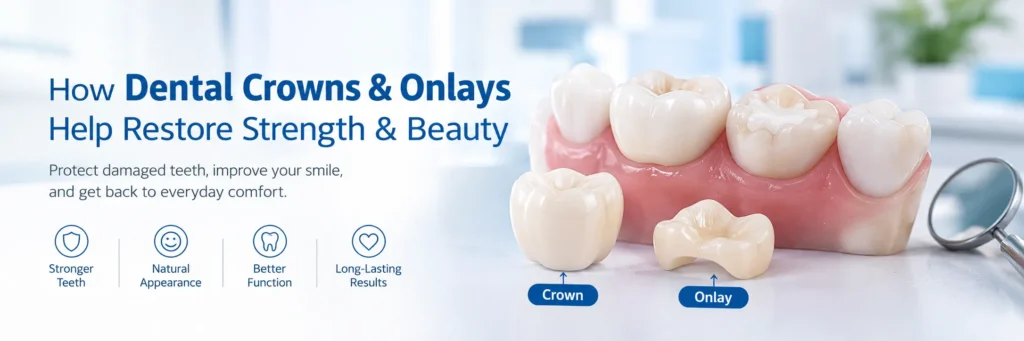
How Dental Crowns & Onlays Help Restore Strength & Beauty
A damaged tooth can affect more than your smile. You might notice discomfort when chewing, worry about a crack getting worse, or feel self-conscious about a tooth that looks different from the rest. The good news is that you may not need to lose the tooth or settle for a restoration that looks unnatural.
Dental crowns and onlays help restore damaged teeth by providing support, improving their appearance, and making everyday activities like eating and speaking more comfortable. The right option depends on how much of your natural tooth remains, the extent of the damage, and your dental needs.
Understanding how these restorations work can help you feel more confident when discussing treatment with your dentist.
What Are Dental Crowns and Onlays?
Dental crowns and onlays are custom-made restorations designed to repair teeth that have lost some of their strength. However, they cover different portions of the tooth. Dental crowns Richmond, sometimes called a cap, covers the entire visible portion of a prepared tooth above the gum line. It restores the tooth’s shape, size, and function while helping protect the remaining structure from further damage.
An onlay covers only the damaged portion of a tooth. It is often recommended when a tooth needs more support than a regular filling can provide but still has enough healthy structure to avoid a full crown.
Both options can help preserve your natural teeth while restoring their appearance and function. Your dentist will examine the tooth and recommend the restoration that best suits its condition.
When Might You Need a Dental Crown?
Not every damaged tooth needs a crown, but certain situations make this restoration particularly useful. If a tooth has lost considerable structure, a regular filling may not provide enough support to withstand everyday chewing pressure.
Here are some common reasons your dentist might recommend a crown.
- Large cavities or fillings that leave the remaining tooth structure weakened.
- Cracked or fractured teeth that need additional protection against further damage.
- Teeth treated with a root canal that require reinforcement because of the amount of tooth structure lost.
- Severely worn teeth affected by years of use or habits such as grinding.
- Misshapen or discolored teeth when a crown is appropriate for improving appearance and function.
A crown can also serve as a supporting structure for a dental bridge or cover a dental implant. The goal is to provide a restoration that fits your bite, protects the underlying tooth where applicable, and looks natural alongside your other teeth.
If you have a tooth that feels weak or looks visibly damaged, a dental examination can help determine whether a crown is the right solution.
How Do Dental Onlays Help Preserve Natural Teeth?
An onlay has the advantage over other restorations by allowing your dentist to repair the damaged portion of the tooth while leaving some of the tooth visible. Therefore, this type of restoration may be beneficial if you have a larger area of damage than can be restored with a traditional filling, but less than what would necessitate a complete crown.
For example, consider what happens when a back tooth has a large cavity on one or more of its chewing surfaces. While a basic filling may provide some support, it will not be sufficient to strengthen the tooth if the remaining tooth structure is weak. An onlay would allow you to cover the affected area and strengthen the tooth, while allowing you to keep a larger amount of your healthy tooth structure intact.
Onlays help restore a damaged tooth’s chewing surface to its original shape and size so that the tooth works better when you eat.
However, there are some instances where an onlay will not be appropriate. When a tooth has significant damage, or if you need to cover more of the tooth, then a crown would be more suitable to help protect it. Your dentist will determine how much of the healthy tooth remains prior to recommending either type of treatment.
Which Materials Are Used for Crowns and Onlays?
Once you know which type of restoration you need, the next question might be about the material. After all, you want your restored tooth to be strong, comfortable, and natural-looking.
Several materials are available, and each has its own advantages.
- Porcelain and ceramic are popular choices when you want a restoration that looks similar to your natural teeth. They can be particularly suitable for teeth that are visible when you smile.
- Porcelain-fused-to-metal restorations combine a metal foundation with a porcelain outer layer. This provides structural support while maintaining a tooth-like appearance.
- Gold alloys are known for their durability and can be useful for back teeth that experience substantial chewing pressure. They may also be gentler on opposing teeth than some ceramic materials.
- Zirconia is a strong ceramic material that can provide a combination of durability and an attractive appearance.
So, which material should you choose? There is no single answer for everyone. A front tooth may need a material that closely matches the surrounding teeth, while a back molar may require greater resistance to chewing forces.
Your dentist will consider the location of the tooth, your bite, any teeth-grinding habits, and your preferences before recommending a suitable material.
What Happens During the Crown or Onlay Procedure?
Knowing what to expect can make the treatment feel less intimidating. The exact process varies depending on the restoration and the condition of your tooth, but a traditional crown generally involves several steps.
1. Examination and treatment planning
Your dentist examines the tooth and may take X-rays to assess the root and identify decay that cannot be seen during a visual examination. This helps determine whether you need a crown, an onlay, a filling, or another treatment.
2. Preparing the tooth
The damaged tooth is carefully prepared to make room for the restoration. Your dentist aims to preserve as much healthy tooth structure as possible. If substantial structure is missing, a core build-up may be needed to create a suitable foundation.
3. Taking impressions
Impressions of the prepared tooth and opposing teeth help capture the details needed to create a restoration that fits properly. These records help the dental laboratory shape the restoration to suit your bite and the surrounding teeth.
4. Placing a temporary restoration
For a traditional crown, a temporary crown may be placed while the permanent restoration is being made. This helps protect the prepared tooth between appointments.
5. Fitting the final restoration
At the next appointment, your dentist checks the fit, bite, shape, and appearance before securing the permanent crown. The goal is to achieve a comfortable fit and a natural-looking result.
Traditional crown treatment commonly requires two visits, with the laboratory preparation period between appointments. Your individual treatment schedule may vary depending on the restoration and the complexity of your case.
How Long Can Dental Crowns and Onlays Last?
You likely would like your restoration to last for as many years as possible. Properly cared-for custom dental crown(s) may last anywhere from ten to twenty years (and possibly even longer). While the duration of time that a dental crown will remain functional will vary among individuals, onlays may also offer long-term benefits if properly chosen, applied, and cared for.
Habits that are performed on a daily basis can affect the life of your restoration. Daily brushing, flossing, regular visits to the dentist for cleanings and check-ups, as well as avoiding habits like chewing on hard things, will all contribute to protecting your restoration.
You should inform your dentist if you find yourself grinding or clenching your teeth. Too much force applied can result in wear, fractures, or other forms of damage to your teeth. Your dentist can help you find a way to control this behavior.
Remember, although a crown or onlay will help protect the remainder of the tooth, it will not prevent other issues from developing with the tooth. It is important to continue to monitor the area around the restoration (i.e., the edge) and the gum tissue surrounding the tooth. Should you notice any ongoing pain/discomfort, a shift in your bite, a loose restoration, or a damaged restoration, please schedule an appointment with your dentist for evaluation.
Why Choose Advanced Dentistry of Richmond?
At Advanced Dentistry of Richmond, we understand that restoring a damaged tooth is about more than filling a space or covering a crack. We want your restoration to support comfortable function while complementing the natural appearance of your smile.
Our approach to crowns, onlays, and bridges focuses on careful treatment planning, preserving healthy tooth structure where possible, and selecting materials that suit your individual needs. We work with selected dental laboratories and skilled ceramists to create restorations with attention to fit, shape, and color.
Ready to restore your smile? Contact us today
Frequently Asked Questions
1. Are dental crowns better than onlays?
Neither option is automatically better. Crowns cover the entire visible portion of a prepared tooth, while onlays restore only the damaged area. An onlay may preserve more natural tooth structure when the damage is limited. Your dentist can recommend the most appropriate option after examining your tooth.
2. Do dental crowns look natural?
Yes. Porcelain and ceramic crowns can be made to match the color and appearance of surrounding teeth. The final result depends on the material, the quality of the restoration, and how carefully it is designed and fitted.
3. Is getting a dental crown painful?
Your dentist uses appropriate local anesthesia during tooth preparation to help manage discomfort. You may experience some temporary sensitivity or soreness afterward. If discomfort is severe or persistent, contact your dental office for advice.
4. How long does it take to get a dental crown?
Traditional crown treatment usually involves two appointments. The first includes examination, tooth preparation, impressions, and temporary crown placement when needed. The permanent crown is generally fitted at a later appointment after it has been fabricated by a dental laboratory.
5. Can a dental onlay prevent the need for a crown?
An onlay may help preserve a tooth without requiring full coverage when enough healthy structure remains. However, it cannot replace a crown in every situation. The right choice depends on the extent of damage, the tooth’s strength, and your bite. Your dentist can explain which restoration is appropriate for your case.