
Looking For The Best Solution For Your Dental Implant? Types Of Implant Restorations Explained
Getting a missing tooth replaced is really just step one. The part people actually see and chew with every day- the restoration sitting on top of the implant- is what makes the whole thing work. And here is the thing: there is not one restoration that fits every mouth. What works depends on how many teeth you are missing, how your jawbone is holding up, and honestly, what kind of day-to-day maintenance you are okay with.
Below, we will go through the different restoration options out there, what sets each one apart, and how your dentist figures out which one actually makes sense for you.
What Is A Dental Implant Restoration?
People throw around the word “dental implants in Richmond VA” like it covers everything, but it is really just one piece of the puzzle. The implant itself is the small titanium post that goes into your jawbone and acts like an artificial root. Once that heals and fuses with the bone (this takes a few months, by the way), an abutment connects it to the restoration on top, and that restoration is the part that actually looks like a tooth.
So you have got three pieces working together: the implant, the abutment, and the restoration. Depending on your situation, that restoration might be a single crown, a bridge, or even a full denture.
What Factors Determine The Right Dental Implant Restoration?
A handful of things usually shape this decision. How many teeth are missing is a big one, obviously, since replacing one tooth is a totally different situation than replacing an entire arch. Bone health matters too. Some restorations need a decent amount of bone to sit on properly, and not everyone has that going in.
Where the missing teeth are located also plays into it; front teeth and back molars just do not carry the same demands. Then there is personal preference: do you want something you can take out and clean, or something fixed that feels closer to your natural teeth? Budget comes into it as well, along with what you are hoping for long-term.
Types Of Dental Implant Restorations
Implants Restorations at Advanced Dentistry of Richmond include the following Dental Implants Restorations:
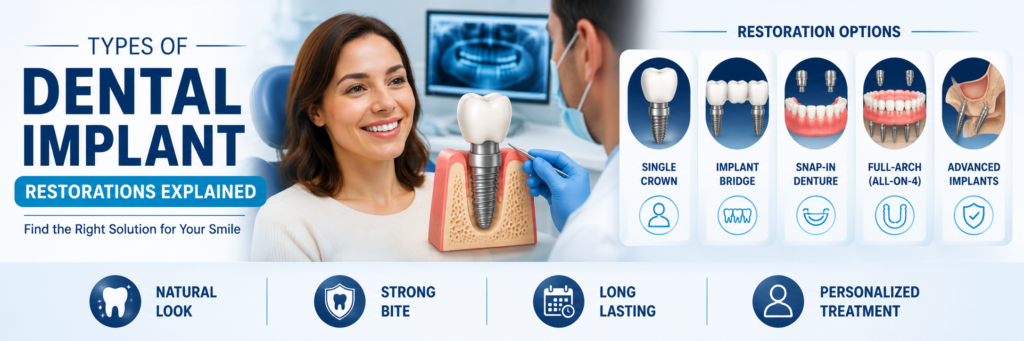
Single Implant Crown
If you are only missing one tooth, this is usually the simplest route. A titanium post takes the place of the root, and a crown made to match your other teeth sits on top. Because it does not lean on neighboring teeth for support, it actually helps protect them long-term. This tends to work best for patients who have solid bone density and just one gap to deal with.
Implant-Supported Bridge
When a few teeth in a row are gone, an implant-supported bridge is often a better call than replacing each one separately. Instead of shaving down healthy teeth to hold up a traditional bridge, implants at each end carry the whole thing. Less wear and tear on your natural teeth, and a result that tends to hold up longer. If you are missing three or more teeth in a row and have enough bone for a couple of implants, this is usually a good fit.
Implant-Retained Overdenture (Snap-In Denture)
For patients missing most or all their teeth, this option uses a small number of implants with attachments that the denture snaps onto. It comes out for cleaning, which a lot of people like, but it is way more secure than a regular denture that can slide around while you are eating or talking. it is a solid middle ground for denture wearers who want more stability but are not ready for something fully fixed.
Bar-Supported Overdenture
This one is similar to the snap-in version, but instead of separate attachment points, a metal bar links the implants together, and the denture clips onto that bar instead. It spreads out the pressure more evenly, which means better stability, especially for people whose lower jaw has shrunk quite a bit over the years. If a locator overdenture does not feel supportive enough, this is often the next step up.
Full-Arch Implant Restoration (All-on-4 or All-on-X)
For patients missing most or all their teeth, this approach replaces a full arch using as few as four implants placed strategically around the jaw. Unlike the overdenture options, this one stays put, it is fixed, not removable. You end up with a full set of teeth that look and feel a lot closer to natural, without the bulk of a traditional denture.
Advanced Implant Restorations for Bone Loss
Some patients just do not have enough bone up top to support regular implants, usually from years of missing teeth or bone loss over time. Zygomatic and pterygoid implants are built for exactly this situation, anchoring into denser bone in other parts of the skull instead. These are specialized options for people with significant bone loss who might have been told a bone graft was their only path forward.
These implants restorations help in
How To Choose The Right Implant Restoration
It really starts with a thorough exam, checking bone density, gum health, your bite, and any teeth you still have. Digital imaging helps a lot here too, giving your dentist Richmond VA a clear picture of your jaw before any planning even begins.
From there, it comes down to what actually fits you. Two patients can look pretty similar on paper and still need completely different restorations.
How Long Do Dental Implant Restorations Last?
The implant post itself can last decades, sometimes a lifetime, if it is cared for properly. The restoration on top usually lasts somewhere between 10 and 20 years, though that range shifts depending on materials and upkeep.
Brushing and flossing well makes a real difference here. So does keeping up with regular dental visits, since small problems are so much easier to fix early. And habits like grinding your teeth or smoking can shorten how long everything lasts, so it is worth paying attention to those too.
Why Choose Advanced Dentistry Of Richmond
Choosing the right dental implant restoration starts with a personalized evaluation. Every smile is different, so we take the time to understand your oral health, the number of teeth being replaced, your bone structure, and your long-term goals before recommending a treatment.
Our team creates customized treatment plans using advanced technology and high-quality materials to deliver restorations that look natural, feel comfortable, and are built to last. Whether you need to replace a single tooth or restore an entire arch, we are here to help you find the solution that is right for your smile.
If you are ready to explore your options, schedule a consultation with Advanced Dentistry of Richmond and let our team help you restore your confidence with a treatment plan designed specifically for you.
FAQs
How do I know if I am a good candidate for dental implants?
It really comes down to your bone health and overall oral condition. A comprehensive exam with digital imaging gives your dentist the full picture, and if bone loss is an issue, options like zygomatic implants might still work for you.
Is a fixed restoration always better than a removable one?
Not necessarily. Fixed restorations tend to feel more natural, but removable options like overdentures are easier to clean and often cost less upfront. It really depends on your lifestyle and what matters most to you.
How often should I see my dentist after getting an implant restoration?
Regular checkups, usually every six months, help catch small issues like loosening or wear before they turn into bigger problems. Your dentist may recommend more frequent visits depending on your specific restoration.