
Different Denture Solutions: What Is The Feeling Of Wearing New Dentures
If you are missing teeth, chances are someone has mentioned dentures to you at some point, but the truth is “dentures” is not really one single thing. There are actually a few different types, and figuring out which one fits your situation is not always straightforward. Some patients still have healthy teeth remaining and just need to fill a few gaps. Others are dealing with the loss of an entire arch and need something built from scratch. And then some patients do not want to go a single day without teeth, even while healing from extractions.
Each of these situations calls for a different approach. And understanding the differences upfront makes the whole process feel a lot less overwhelming. Below, we will break down what sets partial, complete, and immediate dentures apart, then walk through what actually goes into making a set of dentures from start to finish.
What Are Dentures?
At the most basic level, dentures are prosthetic devices, or “false teeth,” designed to replace teeth you have lost. But depending on your situation, you might need a partial, a complete set, or even an immediate version placed right after extractions. Each one solves a different problem.
What Are The Different Denture Solutions?
Different denture solutions are available to replace missing teeth, each offering unique benefits based on your oral health, lifestyle, and smile goals.
Partial Dentures
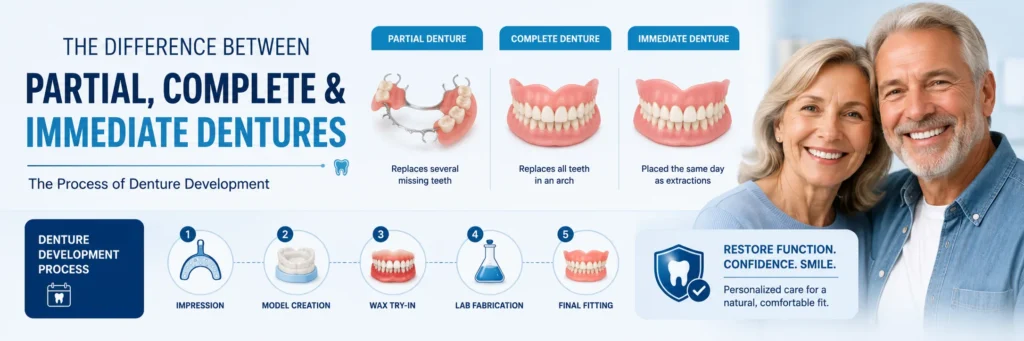
So, the Partial denture solutions come into play when you are missing several teeth but still have healthy natural teeth remaining. Rather than replacing everything, a partial denture fills in the gaps while working around what you have already got. They are usually held in place with a lightweight metal base that clasps onto your adjacent teeth, blending in with your existing smile instead of standing apart from it.
Beyond just filling gaps, partials actually do some heavy lifting functionally. They help restore balance to your bite, make chewing easier, and, maybe most importantly, they stop your remaining teeth from shifting out of place over time. Once a gap opens up, neighboring teeth tend to drift toward it, so a partial denture keeps everything where it belongs.
Complete Dentures
Complete dentures are a different story altogether. These are for patients who have lost all their teeth in the upper arch, lower arch, or both, and they are built entirely custom for each patient. Prosthodontists, specialists trained specifically in this kind of restorative work, are the ones who typically handle the design and fabrication of these appliances.
Made from high-quality acrylic or more advanced composite materials these days, complete dentures are not just about looks. They bring back the ability to chew and speak comfortably, and they restore facial support that is often lost once all natural teeth are gone. Modern denture-making has come a long way too, so the fit tends to be better and the appearance more natural than what people might picture from older-generation dentures.
One thing worth mentioning, complete dentures do not always have to stay as they are. In some cases, they can be converted into implant-supported hybrids later on for added stability, if that is something a patient wants to explore down the road.
Immediate Dentures
Immediate dentures solve a very specific problem: nobody wants to walk around without teeth while healing from an extraction. These are custom-made ahead of time, based on impressions taken before the teeth are actually removed, so the denture is ready to go in the very same day as surgery.
That said, immediate dentures come with a bit of a catch. Once teeth are removed, the gums and underlying bone naturally reshape themselves as they heal. Because of that, immediate dentures usually need some adjustments along the way, sometimes a reline, and eventually a replacement with a more permanent set once healing is complete. Even with that extra step, they are incredibly valuable for maintaining facial structure and confidence during what can otherwise be an awkward transitional period, especially for anyone going through full-arch extractions.
What Is The Feeling Of Wearing New Dentures?
Wearing new dentures takes some getting used to, no way around it. Most people describe a feeling of fullness at first, almost like there is too much in their mouth, along with extra saliva production for the first few days.
Talking can feel a little off too, certain words might come out with a slight lisp until your tongue and cheeks adjust to the new shape. Eating takes patience as well, starting with softer foods usually helps. The good news is these sensations fade fairly quickly for most patients, often within a couple of weeks, as your mouth muscles learn to work with the denture instead of against it.
How Are Dentures Actually Made?
People are often surprised by how much goes into building a set of dentures. It is not a one-visit process; it typically takes several weeks and multiple appointments to get everything right.
It starts with impressions of your edentulous arches, along with measurements of how your upper and lower arches relate to each other and how much space sits between them. At this stage, denture teeth are chosen to match your specific facial features; there is actually a wide range of shapes, shades, and forms to pick from.
From there, plaster models are created, along with a wax form or acrylic pattern shaped exactly like the final denture will be. This “try-in” version gets checked in your mouth for color, shape, fit, and even how it affects your speech, before anything moves forward to final production.
Once everything checks out, the final denture is manufactured by a dental laboratory. And even after delivery, adjustments are pretty normal, both on the day you receive your dentures and at follow-up visits, since your mouth needs a little time to adjust to something new.
Why Choose Advanced Dentistry Of Richmond
Dentures are not one-size-fits-all, and figuring out whether a partial, complete, or immediate denture makes sense for you really depends on your specific situation.
At Advanced Dentistry of Richmond, we combine specialized prosthodontic training with personalized care to help you choose the denture solution that best fits your needs. As part of our comprehensive cosmetic dentistry in Richmond services, we create dentures designed to fit comfortably, restore function, and enhance the appearance of your smile. If you are ready to explore your options, schedule a consultation with our team today.
FAQs
Does insurance cover the cost of dentures?
Coverage really depends on your specific insurance plan. Some policies cover a portion of denture costs while others do not include them at all. It is worth calling our office so we can help you understand what your plan covers. And walk you through the payment options available.
How long does the denture-making process take?
The full process usually takes several weeks and involves multiple appointments, from initial impressions to the final delivery. Dr. Klostermyer will walk you through each step. Also, including any adjustments needed once you start wearing your new dentures.
Will my dentures need adjustments after I get them?
Yes, this is completely normal. Whether you have complete, partial, or immediate dentures, your gums and bone can shift slightly as you adjust. So, follow-up visits for relining or minor adjustments are a standard part of the process.