
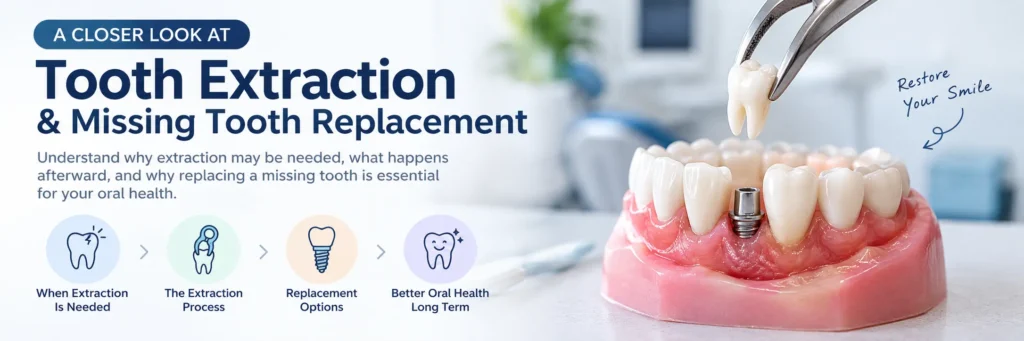
A Closer Look at Tooth Extraction: The Importance of Replacing a Missing Tooth
Losing a tooth can happen for several reasons, including severe decay, damage, or periodontal disease. When a tooth can no longer remain in place, extraction may be recommended to protect your overall oral health. However, the process does not necessarily end once the tooth has been removed. What happens afterward can also have an important effect on your teeth, bite, and ability to chew comfortably.
Understanding why a tooth may need to be extracted and why replacing it afterward matters can help you make informed decisions about your dental care.
What Is a Tooth Extraction
A tooth extraction in Richmond is a dental procedure in which a tooth is removed from its socket in the bone. Extraction may become necessary when a tooth has significant damage or decay that cannot be adequately addressed, or when overcrowding affects the position and function of the teeth.
Because extraction is a surgical procedure, it is important that it is performed by an appropriately trained dental care provider. Depending on the situation, an oral surgeon or periodontist may need to perform the extraction.
The procedure is generally completed using local anesthesia to keep you comfortable. In appropriate cases, additional options such as nitrous oxide or IV sedation may also be available to help you feel more relaxed during treatment.
The goal is not simply to remove the tooth. Careful planning and specialist involvement can help reduce risks and support a smoother experience.
Why Tooth Extraction May Be Necessary
A damaged or severely decayed tooth can affect more than just the tooth itself. When a tooth can no longer be maintained, leaving it untreated may create additional oral health concerns.
Overcrowding is another possible reason for extraction. When there is not enough room for all the teeth to fit properly, removing a tooth may sometimes be necessary as part of a broader treatment plan. Because of orthodontics and the ability to move teeth, we try to avoid removing teeth from overcrowding as much as possible.
Every situation is different, which is why an appropriate dental professional should evaluate the condition of the tooth and surrounding structures before recommending extraction.
What Happens After a Tooth Is Removed
One of the most important things to consider after an extraction is the space left behind.
When a tooth is removed, neighboring teeth may gradually begin moving toward the open space. Adjacent teeth can tip or shift, while the opposing tooth may move into the space that was previously occupied by the missing tooth.
This movement does not necessarily happen immediately. It can develop gradually over time, which means the effects of an untreated missing tooth may not be obvious at first.
As the surrounding teeth move, your bite and overall alignment can change. These changes may affect how comfortably you chew and may also contribute to jaw joint concerns.
With larger extractions some people may also experience small changes in their facial features as bone remodels and slightly shrinks since the area is no longer occupied by a functioning tooth. This is why bone grafting procedures should almost always be discussed.
Why Replacing a Missing Tooth Matters
Replacing a missing tooth is an important part of maintaining proper oral function and alignment.
When surrounding teeth shift into an open space, they can become more difficult to clean effectively. Areas that are harder to reach may increase the risk of problems such as gum disease and tooth decay. Changes in tooth position can also contribute to further tooth loss.
There can also be consequences for future tooth replacement. As teeth move, the original space may no longer provide the ideal position for a restoration. In some cases, additional treatment may then be needed to recreate a suitable site.
Depending on the circumstances, this may involve orthodontic treatment, bone grafting, or other procedures before the missing tooth can be replaced.
For these reasons, discussing tooth replacement before or soon after an extraction can help you understand your options before unwanted changes develop.
What Are the Options for Replacing a Missing Tooth
There is no single replacement option that works for everyone. The appropriate restoration depends on factors such as your oral health, the location of the missing tooth, and your individual needs.
Dental Implants
A dental implant can be used to replace a missing tooth and restore the space with a fixed dental restoration. Implants are one option that may be considered when replacing a lost tooth.
Dental Bridges
A dental bridge can replace a missing tooth by using the surrounding teeth to support the restoration. This can provide another option for restoring the open space and improving dental function.
Removable Partial Dentures
A removable partial denture is another option for replacing one or more missing teeth. It can be removed when needed and may be recommended depending on the patient’s specific circumstances.
Choosing between these options requires careful evaluation. A dental professional can explain the benefits and considerations of each approach and help determine which restoration is appropriate for you.
Why Timing Matters After Tooth Extraction
It can be tempting to delay replacing a missing tooth, particularly if the area is not causing immediate discomfort. However, the longer an open space remains, the more opportunity there may be for surrounding teeth to shift and bony changes to take place.
Changes in tooth position can affect alignment, chewing, and the ability to maintain proper oral hygiene. They can also make future restoration more complicated.
Replacing a missing tooth soon after it is lost may help preserve the space and make future treatment more straightforward. The right timing will depend on your individual situation, so discussing your options with your dental team is an important step.
How Your Dental Team Can Help
Tooth extraction is only one part of managing a severely damaged, decayed, or overcrowded tooth. Planning for what happens afterward is equally important.
Your dental team can assess your oral health and discuss whether extraction is appropriate. If the tooth needs to be removed, you can also discuss possible replacement options and the ideal timing for restoring the missing tooth.
A personalized approach allows treatment to focus not only on the immediate extraction but also on maintaining your oral function and supporting your long-term dental health.
Why Choose Advanced Dentistry of Richmond
At Advanced Dentistry of Richmond, patient comfort and personalized care are central to our approach. As restorative specialists focused on prosthodontic care, we entrust surgical procedures such as tooth extractions to highly trained oral surgeons or periodontists.
We work with the appropriate dentists in Richmond to help ensure that your extraction is handled carefully and efficiently. Local anesthesia is used during the procedure, while nitrous oxide or IV sedation may be available when appropriate to support a more comfortable experience.
After a tooth is lost, we can also help you understand your replacement options. Whether a dental implant, bridge, or removable partial denture may be appropriate, our team can provide personalized guidance based on your needs.
If you have a damaged, decayed, or overcrowded tooth, or you are already living with a missing tooth, contact us to discuss your next steps.
FAQs
Q1: Is tooth extraction painful?
A1: Tooth extraction is generally performed under local anesthesia to help keep you comfortable during the procedure. Depending on the situation, nitrous oxide or IV sedation may also be available to help with relaxation.
Q2: Why should I replace a tooth after extraction?
A2: Replacing a missing tooth can help prevent neighboring and opposing teeth from shifting into the open space. Tooth movement can affect alignment, chewing, cleaning, and future replacement options.
Q3: How soon should a missing tooth be replaced?
A3: The best timing depends on your individual situation. However, replacing a missing tooth soon after it is lost can help reduce the potential for surrounding teeth to shift and may make future restoration more straightforward.
Q4: What are my options for replacing a missing tooth?
A4: Common options include dental implants, bridges, and removable partial dentures. A dental professional can evaluate your needs and recommend an appropriate restoration.
Q5: Who performs a tooth extraction?
A5: Tooth extractions are surgical procedures and may be referred to a highly trained oral surgeon or periodontist. The appropriate specialist can perform the procedure based on your specific dental needs.