
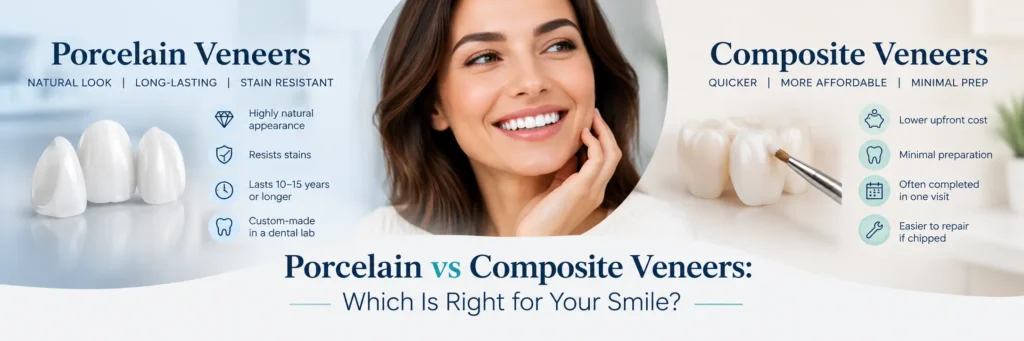
Porcelain vs Composite Veneers: Which Is Right for Your Smile?
Choosing between porcelain and composite is one of the first decisions patients face when they begin planning a smile change. Both materials can close small gaps, reshape uneven edges, and cover discoloration that whitening cannot fix.
The two options behave very differently over time, and the right choice depends on your goals, your bite, and your budget. A clear comparison of porcelain veneers with composite dental filling will help you ask better questions at your consultation and avoid choosing on price alone.
This guide explains how each material is made, how long it tends to last, and where each one fits best. It also covers cost, upkeep, and the role a prosthodontist plays in the final decision.
How Do the Two Materials Differ?
Porcelain restorations are thin ceramic shells, often about half a millimeter thick, made in a dental laboratory from impressions or digital scans of your teeth. Each shell is shaped and shaded for one specific tooth, then bonded to its front surface at a second appointment.
Composite restorations are built directly on the tooth from tooth-colored resin. The dentist places the material in thin layers, sculpts it by hand, and hardens each layer with a curing light.
In simple terms, one material is fabricated outside the mouth and the other is built inside it. That single difference drives most of the contrasts in strength, appearance, and cost that you will see in the sections below.
When Does Porcelain Make Sense?
Porcelain is the material most cosmetic dentists choose when the goal is a long-lasting and highly natural result. Its glass-like surface reflects light much like natural enamel does, which is why it looks lifelike both in photographs and in person.
The ceramic also scatters light in a way that gives the edges of the teeth a slightly translucent quality. That depth is difficult to copy with resin, especially across a full row of front teeth.
Key strengths
- It resists stains from coffee, tea, and red wine far better than resin does.
- It can hold its color and shine for ten to fifteen years or longer with good care.
- The laboratory process allows fine control over shape, translucency, and shade.
- It bonds strongly to enamel, which supports long-term stability.
Points to consider
- Preparation usually removes a thin layer of enamel, so the step cannot be reversed.
- Treatment takes at least two visits, with a temporary shell worn in between.
- A chipped shell is typically replaced instead of repaired.
When Is Composite the Better Choice?
Composite suits patients who want a faster and more conservative change, or who are treating only one or two teeth. Because the resin is bonded directly, little or no enamel needs to be removed, and many cases are finished in a single visit.
It also works well as a gentle first step for younger patients, or for anyone who wants to preview a change before committing to a permanent one.
Key strengths
- The upfront cost is lower than for a laboratory-made restoration.
- Minimal preparation keeps more of the natural tooth structure intact.
- A small chip can usually be repaired or smoothed without starting over.
- Treatment is often completed in one appointment without a temporary.
Points to consider
- Resin absorbs stains more readily and may need polishing every year or so.
- The typical lifespan is closer to five to seven years before replacement.
- The final look depends heavily on the skill of the dentist who sculpts it.
How Do Cost, Time, and Upkeep Compare?
Composite usually costs less on the day of treatment, while porcelain often evens out over the years because it is replaced less frequently. Exact fees vary from case to case, so a written treatment plan is the only reliable way to compare.
- Time: porcelain needs two visits, while composite is often finished in one.
- Lifespan: porcelain commonly lasts ten to fifteen years, and composite lasts about five to seven.
- Upkeep: both need daily brushing and flossing, and composite may need periodic polishing.
For front teeth that show with every smile, porcelain veneers Richmond are generally the more durable choice. Composite remains a sensible option for minor changes, for patients who prefer a reversible approach, or as a trial before a larger commitment.
Whichever material you select, avoid biting ice, pen caps, or fingernails. If you grind your teeth at night, ask about a custom night guard to protect the restorations.
Which Option Fits Your Situation?
A few practical questions usually point toward one material or the other. Your answers also give your dentist a useful starting point for planning.
Better suited to porcelain
- You want a result that stays bright for a decade or more.
- You are treating several visible teeth at once.
- You are comfortable with a small, permanent change to the enamel.
Better suited to composite
- You are correcting one or two teeth with minor chips or gaps.
- You prefer a lower upfront cost and a shorter treatment time.
- You want to keep as much natural tooth structure as possible.
How Does a Prosthodontist Help You Decide?
A prosthodontist is trained in restoring and replacing teeth, so the evaluation covers more than color and shape. The exam looks at your bite, the health of your gums, and any wear patterns that could shorten the life of a restoration.
That wider view matters because a beautiful result still has to function well. Grinding, a deep bite, or an uneven tooth position can all change which material is the safer choice.
What to expect at a consultation
- A full exam with photographs and digital scans.
- A frank discussion of your goals, timeline, and budget.
- A preview of the planned shape and shade before treatment begins.
Why Choose Advanced Dentistry of Richmond?
Advanced Dentistry of Richmond is a women-owned prosthodontic practice led by Dr. Ursula Klostermyer, with Dr. Franziska Klostermyer focusing on cosmetic smile work and full-mouth rehabilitation. The team offers both porcelain and composite options alongside implants, crowns, and bridges, so your plan can be built around one coordinated diagnosis. Every patient begins with a private consultation centered on personal goals and long-term oral health.
Frequently Asked Questions
How long does each material last?
Porcelain commonly lasts ten to fifteen years or longer, while composite typically lasts five to seven years. Habits such as grinding, nail biting, and skipping dental visits can shorten the life of both.
Is the procedure painful?
Discomfort is usually minimal. Composite often needs no anesthetic, while porcelain preparation is normally done under local anesthetic so you stay comfortable throughout the visit.
Can either material be whitened later?
No, neither porcelain nor composite responds to whitening gels. Natural teeth are best whitened first, and the restoration shade is then chosen to match the result.
Will the treatment harm my natural teeth?
Porcelain involves removing a thin layer of enamel, which is permanent but small and carefully controlled. Composite usually needs far less preparation, and neither approach harms a tooth when it is properly planned and maintained.
Can I eat normally afterward?
Yes, once the bonding has fully settled. Avoid very hard foods such as ice or hard candy, and cut firm items like raw carrots into smaller pieces to protect the restorations.